|
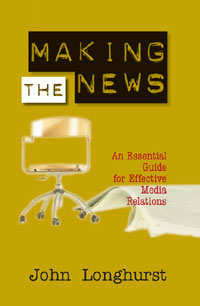
REVIEWBook launch provides insights into ‘making the news’By Leona Dueck Penner Fittingly, the recent launch of John Longhurst's updated book, Making the News: An Essential Guide for Effective Media Relations, included local newsmakers. Bob Cox, editor of the Winnipeg Free Press, and Terry McLeod, host of CBC Information Radio, joined Longhurst in a “Religion and the media” presentation, offering helpful hints on how faith-based non-profit organizations can better “make the news.” Their tips included: The use of Longhurst's book as a resource. “It's very good for anyone because it's realistic,” said Cox.” I recommend it in my workshops because it's simple and engaging,” added McLeod. Build long-term relationships with the media. This is “key to getting the message out, said Cox, adding that this “takes not years, but decades.” Decide if your organization really wants to communicate with the media. “Some try to keep us out,” said Cox. Put people—not the organization—at the beginning of the story. “People are key,” said McLeod. “Wider stories are best seen through the eyes of ordinary individuals. In radio, I look for that.”. Tailor stories for a specific news outlet. “Radio is different from a daily paper,” said McLeod. “We seek to reflect diversity and the changing nature of our province . . . Change is key.” Focus on what is new. That is the bottom line of a story. Find key communicators in your organization and utilize their skills. Longhurst, who is currently director of communications and marketing at Canadian Mennonite University, wrapped up the presentation by reading the conclusion of his book. He emphasized the larger goal of non-profit organizations, which is to “share good news, the good things that happen in the world [which] often fly under the media radar, unless someone brings it to their attention. Our job as communicators is to help ordinary people. tell their stories of human possibility.” A wide-ranging discussion period followed. Listeners raised questions related to the truth of news-story aphorisms, such as “if it bleeds it leads,” and “timeliness is next to godliness,” as well as challenges about the “negative reporting” of Muslims, which some seemed to think is happening in the media now. “Timing is everything,” Cox acknowledged. As for the negative reporting about Muslims, “it's largely a lack of understanding,” he said. The lack of a Muslim point of view among staff and the wider community is a problem, he acknowledged, which makes it “a big job” to provide balanced coverage. Originally published in Canadian Mennonite Volume 10, No. 19 October 2, 2006. |
